Red foxes have expanded into tundra regions of Eurasia and North America during the last century. By being opportunistic predators and fierce competitors, invading red foxes threaten arctic fox and ground-nesting bird populations. To help protect these species against red foxes, this new study investigated how red foxes move within the tundra. COAT researchers found that red foxes moved large distances during winter, and that red foxes preferred habitats close to the marine coastline and with high human land use intensities. These results suggest that the marine coastline and human land use provides important food resources for red foxes. Reducing waste and feeding by humans will therefore likely help reduce red fox densities. Furthermore, hunting of red foxes likely has the highest local effect during spring and summer, when they move less far.
Red fox with a GPS collar. Photo: Joachim Henriksen.
The Varanger Peninsula in northeastern Norway is home to one of Europe’s few Low Arctic tundra ecosystems. Red foxes on Varanger, which have increased in abundance, threaten an endangered population of Arctic foxes and ground nesting birds such as ptarmigan. To conserve these species, red foxes are heavily hunted, but the effect of hunting is not always clear. This is because little is known about the scales at which red foxes move within the tundra. We also know little about the importance of human foods such as waste to red foxes on Varanger. To answer these questions, we trapped 14 red foxes between 2021-2025 and equipped them with a small GPS collar weighing 170 grams. The collars enabled us to track individual foxes during a whole year.
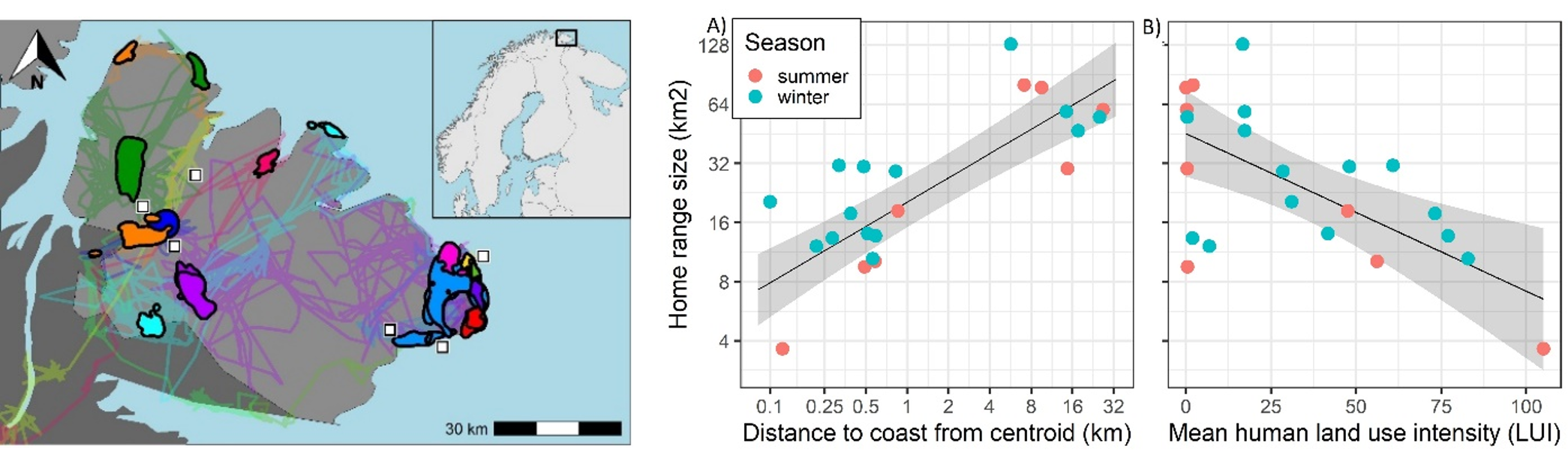
The home ranges of 14 red foxes tracked on Varanger Peninsula were found to be smaller at closer distances to the coastline and smaller at higher human land use intensities. Within these individual home ranges, foxes were also found to prefer habitats close to the coast and prefer habitats with higher human land use intensities. These results suggest that the marine coastline and human land use provide important food resources to red foxes on Varanger.
Predators on the Arctic tundra often face periods of food scarcity. To survive in this harsh environment, red foxes on Varanger appear to take advantage of easily available and predictable food items. The marine coastline provides access to seabirds, marine invertebrates or other food resources like carrion that may drift onshore. Human land use can generate food subsidies from waste, intentional feeding or roadkill. Reducing the availability of these food resources may help reduce red fox numbers on Varanger.
Red foxes moved larger distances during winter than during summer. Hunting of red foxes may therefore be more effective (have a higher local impact) during late spring and summer, when they move less.
Red foxes also moved further distances during winter than summer. Lower food availability during winter may force foxes to move further distances in search of food. Red foxes are also known to disperse and mate during winter, which also explains why they may move further distances during this time.
Full paper